Campine

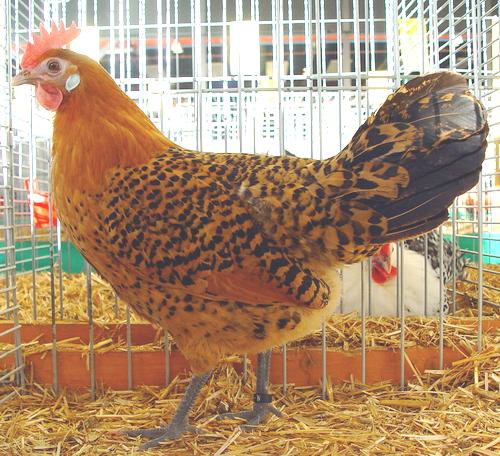
The Campine chicken, pronounced Kam-peen, is a beautiful and rare breed that originated in the Kempen Country near Antwerp, Belgium. They are close relatives of the Belgian Braekel. The Campine chicken comes in two varieties, the Silver and the Golden. Hens and roosters are nearly identical in feather coloration.
In 1893, Campine chickens were first imported into America by Mr. Arthur D. Murphy of Maine and the American Poultry Association recognized the breed in 1914.
Characteristics
Type: Large Fowl
Size: Male: 6lb. / Female 4lb.
Purpose: Egg Laying
Recognized Varieties: Silver & Golden
Crested: No
Feathered Legs: No
Number of Toes: 4
Single comb
Moderately cold tolerant
Not especially docile
Non-setter
Not broody
Tolerates confinement
Alert, intelligent, active
Egg Production
Expect about 3 medium to large white-shelled eggs per week.
Sexing
When Silver Campine females are mated to Golden Campine males the chicks can be sexed at day-old – the female chicks have a reddish blush and the males have gray on the top of their heads.
ALBC Status: Critical
For more information about the Campine visit the ALBC (American Livestock Breeds Conservatory.)

Back to Chicken Keeping Resources HOME PAGE

Orpington

The Orpingtons are very sweet, and friendly, and are seldom bullies towards the other members of the flock. However, living in the desert where the temperatures reach well over 110 they have proven their tolerance for heat to be quite low. Especially considering they can be broody and won’t leave the coop where temperatures can be life-threatening. Every situation is different and they may be fine as free-range chickens with plenty of shade and water.
Details of the Buff Orpington:
Type:   Large Fowl & Bantam
Size:   7-8 pounds
Purpose:   Dual (meat or egg production)
Recognized Varieties:   Buff, Black, Blue, White, (buff is most common.)
Eggs:
Color:  Brown
Size:  Large
Frequency:  3-4 per week
Breed Features:
Feathered Legs: No
Crested: No
Comb Type: Single Comb
Number of Toes: 4
Character & Traits:
Accepts confinement well
Cold Hardy
Heat tolerant to 100 degrees
Docile, friendly
Broody / Setter
Good layers through the winter

Back to HOME PAGE


Dominique

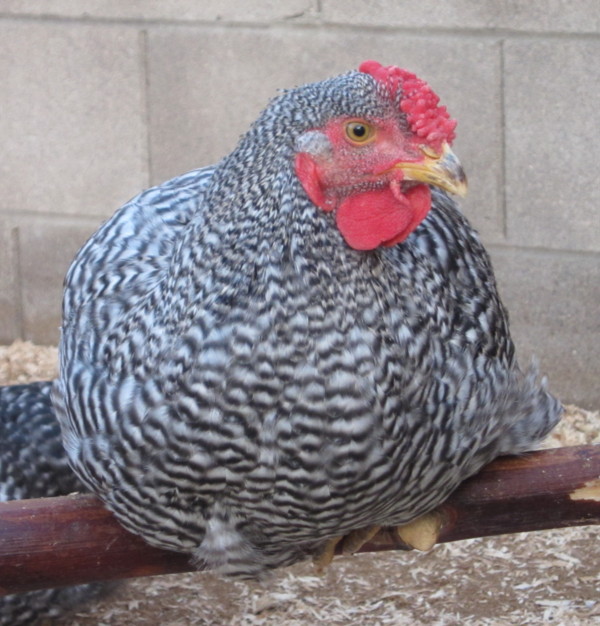
The Dominique, also known as Dominicker,  originated in the United States. They are considered America’s oldest breed of chicken, probably descending from chickens brought to New England from southern England during the Colonial Era.  However, most modern Dominiques may be traced to stock developed by A. Q. Carter after 1900.
By the 19th century, they were widely popular and were raised in many parts of the country. The Dominique is a dual-purpose breed, being valued for meat and brown eggs. They weigh 5 to 7 pounds at maturity, are considered cold-hardy, are good mothers, and adapt well to confinement or free range. They are early to mature, and although sometimes considered flighty, I personally find them extremely calm. The birds’ plumage pattern, also known as “hawk coloring”, offers some protection against some aerial predators.

Egg Production
Although categorized as a dual-purpose breed, these birds are first and foremost egg producers with hens averaging 230-275  medium-sized brown eggs.
Sexing Dominique Chicks
Sexing the Dominique is really pretty simple, with about 95% accuracy.  The cockerels have yellow shanks and toes, and the pullets have a grayish-black coloration on the front of their shanks and also on the top of their toes.  The color differences become less apparent as the chicks mature.
Popularity Concerns
Since the 1920′s the Dominique’s popularity was on a steady decline, by 1970 only four known flocks remained.  Dedicated breeders participated in a breed rescue and their numbers showed a rise in numbers from 1983 to 2006.  By 2007, once again a decline was observed.  Presently, the American Livestock Breeds Conservancy (ALBC) has put the Dominique on the ‘Watch’ list.
Of all the breeds of chickens I’ve kept here on the farm, the Dominique is by far my favorite.  They are very sweet, hardy, and most important in these parts, tolerant to our hot summer temperatures that climb above 110.

Back to HOME PAGE