Laying Hens and How Light Effects Egg Production

Why Egg Production is Low During the Winter Months

Light is one of the most important environmental factors affecting egg production in hens. This is because hens are photoperiodic animals, which means that their reproductive system is regulated by the amount and duration of light they receive.
Regulation of the Reproductive Cycle:
Light affects the reproductive cycle of hens by regulating the secretion of hormones such as melatonin, which is produced by the pineal gland in response to changes in light. Melatonin has been shown to have an inhibitory effect on the reproductive system of hens. When hens are exposed to increasing amounts of light, the production of melatonin is suppressed, and this stimulates the release of follicle-stimulating hormone (FSH) from the pituitary gland, which in turn stimulates the development of ovarian follicles and the production of eggs.
Increase in Day Length:
Hens require a certain amount of daylight to stimulate their reproductive system. Typically, hens require between 14 and 16 hours of daylight per day to achieve maximum egg production. When the days are shorter, such as during the winter months, the decrease in daylight can lead to a decrease in egg production. When the days are longer, such as during the summer months, hens are exposed to more daylight, which can stimulate egg production.
Light Intensity:
The intensity of light can also affect egg production in hens. Hens require a minimum level of light intensity to be able to see their surroundings and engage in normal activities such as eating and drinking. In addition, hens require a certain level of light intensity to stimulate their reproductive system. When the light intensity is too low, it can lead to a decrease in egg production.
Light Color:
The color of light can also affect egg production in hens. Studies have shown that blue light can stimulate egg production in hens, while red light can have an inhibitory effect. This is because blue light has been shown to increase the production of FSH, while red light has been shown to increase the production of melatonin.
Interesting Fact: By controlling the duration, intensity, and color of light, farmers can manipulate the reproductive cycle of hens and increase their egg production.
Back to HOME PAGE

More on Composting with Chickens

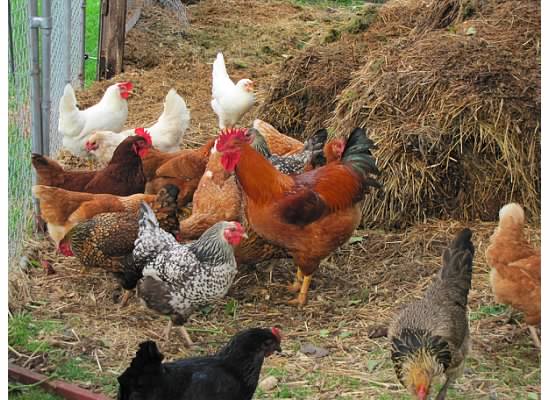
Whether you have a large or small chicken yard, just a couple chickens or hundreds, you can still have chickens help you with your compost.
The best way is to just throw all your compostable materials right into the chicken yard. It will better utilize their manure by incorporating it with the other materials, instead of causing mud, rain runoff and compacted dirt & manure… Continue Reading

by backyardchickens BYC

Further Reading on Composting Manure

Back to Chicken Keeping Resources HOME PAGE

About Grit, your Chicks, and Chickens

Whether or not your flock needs grit is a common question, and the answer can be complicated considering there are different factors to consider. If you’ve already done some research then you know the answer is also a controversial one.  Well, there is an answer, and once you understand what grit is and what it’s for, you can make your own decision on whether or not your flock needs it.
Chickens do not have teeth and grit is used to help digest their food. That’s it, plain and simple! If your birds are in confinement and eat only commercial feed then grit is not necessary. Commercial feeds are formulated to be very easy to digest. But if your chickens are eating other foods that you offer, or are allowed to forage, you may need to provide grit.
What is Grit?
Grit is nothing more than granite, crushed into two different sizes, small for chicks, and larger for chickens.
For Chicks
It’s recommended that baby chicks be provided with grit, then again, chick starter is a commercial feed that is easily digested, so…  grit isn’t exactly vital to their survival either. But, to be safe, yes, I provide grit as a supplement to my chicks in the brooder. You can use grit or clean sand and sprinkle it on the bottom of the brooder, mix it in the feed, or free-feed it. Doesn’t matter, I’ve experimented all three ways and can’t honestly say one is better than the other.
For Chickens
If your chickens are allowed to forage either in a confined area or on acreage there’s only one thing you need to know. What are they foraging on? Is there adequate natural grit underfoot?  If they are confined to a run built off their coop with grass or wood shavings for footing then they need grit, especially if you offer them table scraps.  Here in Phoenix, the ground is granite, so my hens are scratching around on a natural source of grit all day so there’s absolutely no need to feed grit.
Grit is available at your local feed store, it’s cheap and usually sold by the pound. Or, it might be right on your own property, and free!
Just a note…
Chicken grit and oyster shell are not for the same purpose. Grit aids in digestion and oyster shell is used to provide calcium to your laying hens.

Back to HOME PAGE