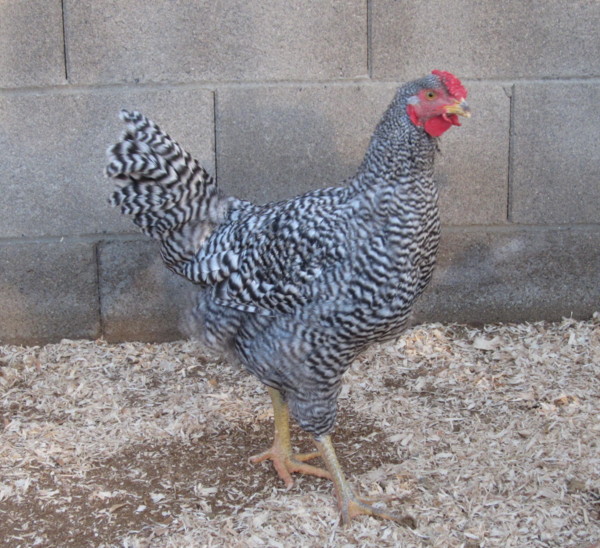
Dominique

The Dominique, also known as Dominicker,  originated in the United States. They are considered America’s oldest breed of chicken, probably descending from chickens brought to New England from southern England during the Colonial Era.  However, most modern Dominiques may be traced to stock developed by A. Q. Carter after 1900.
By the 19th century, they were widely popular and were raised in many parts of the country. The Dominique is a dual-purpose breed, being valued for meat and brown eggs. They weigh 5 to 7 pounds at maturity, are considered cold-hardy, are good mothers, and adapt well to confinement or free range. They are early to mature, and although sometimes considered flighty, I personally find them extremely calm. The birds’ plumage pattern, also known as “hawk coloring”, offers some protection against some aerial predators.
Egg Production
Although categorized as a dual-purpose breed, these birds are first and foremost egg producers with hens averaging 230-275  medium-sized brown eggs.
Sexing Dominique Chicks
Sexing the Dominique is really pretty simple, with about 95% accuracy.  The cockerels have yellow shanks and toes, and the pullets have a grayish-black coloration on the front of their shanks and also on the top of their toes.  The color differences become less apparent as the chicks mature.
Popularity Concerns
Since the 1920′s the Dominique’s popularity was on a steady decline, by 1970 only four known flocks remained.  Dedicated breeders participated in a breed rescue and their numbers showed a rise in numbers from 1983 to 2006.  By 2007, once again a decline was observed.  Presently, the American Livestock Breeds Conservancy (ALBC) has put the Dominique on the ‘Watch’ list.
Of all the breeds of chickens I’ve kept here on the farm, the Dominique is by far my favorite.  They are very sweet, hardy, and most important in these parts, tolerant to our hot summer temperatures that climb above 110.

Back to Chicken Keeping Resources HOME PAGE

Feed Store Chicken Lottery

The Pullet is a Rooster? Options and Solutions

They’re pullets, all female, and that’s why you bought those cute little chicks from the feed store. You certainly didn’t expect to get stuck with a rooster, but now you’re the unlucky one who has fallen into that teeny tiny margin of error and has an unwanted cockerel.
Considering your Options
Check your city ordinances, roosters are often banned in suburban areas, so considering the impossibility of hiding him, an eviction notice is definitely in order. I know this is a hard decision, but it only takes one neighbor to complain and the law will be snooping and sniffing around your property.
If you are allowed to have a rooster you still may have a problem if you already have one. Rule of thumb… more than one rooster to a flock is a no-no.  Another thing to consider is your hen’s eggs are going to be fertile, not exactly an ideal situation if you’re selling eggs.
Not all chicken keepers raise meat birds, so we folks who keep only layers have completely ruled out killing and cooking one of our birds for dinner. That’s an art in itself, and if you’re like me, one better left to somebody else.
Check with the feed store you bought the bird from, sometimes they’ll take it back.  But realistically, most unwanted cockerels share the same fate, a dinner plate.
If the feed store idea is a bust, it’s time to re-home the roo. Ask friends who might live in a more rural area. Craig’s List has come through for me time and time again. Last year I had six roosters to re-home, and they all sold for $5 bucks each.  Just keep in mind, cock fighting does exist, so weed out the riff-raff and dust off your good judge of character skills.
Beat the Odds of the Chicken Lottery
There is a solution to that 1% margin of error when buying sexed chicks.  If you want to be assured you’ll never get stuck with a rooster again, buy sex-linked chicks.  They’re idiot-proof in the sexing department because the hens hatch one color and the roosters another.  They’re hardy, and I wouldn’t be surprised if they wrote the book on egg laying.
Sex Link Chickens
Two common varieties are the black sex-link (also called Black Stars) and the red sex-link (also called Red Stars).

Back to Chicken Keeping Resources HOME PAGE

Promoting the Dominique

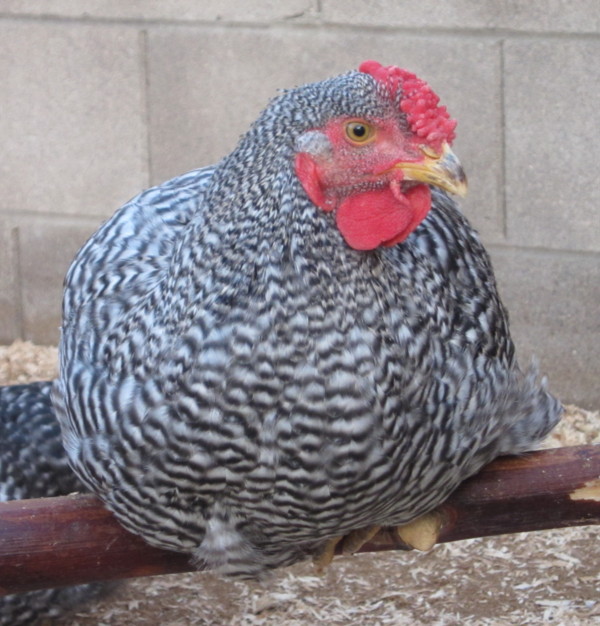
TBN’ Ranch’s Dominique Hen, ‘Mamma Too”

The Dominique, also known as Dominicker,  originated in the United States. They are considered America’s oldest breed of chicken, probably descending from chickens brought to New England from southern England during the Colonial Era.  However, most modern Dominiques may be traced to stock developed by A. Q. Carter after 1900.
By the 19th century, they were widely popular and were raised in many parts of the country. The Dominique is a dual-purpose breed valued for meat and brown eggs. They weigh 5 to 7 pounds at maturity, are considered cold-hardy, are good mothers, and adapt well to confinement or free range. They are early to mature, and although sometimes considered flighty, however, I find them extremely calm. The birds’ plumage pattern, also known as “hawk coloring”, offers some protection against some aerial predators.
Egg Production
Although categorized as a dual-purpose breed, these birds are first and foremost egg producers with hens averaging 230-275  medium-sized brown eggs.
Sexing Dominique Chicks
Sexing the Dominique is really pretty simple, with about 95% accuracy.  The cockerels have yellow shanks and toes, the pullets have a grayish-black coloration on the front of their shanks and also on the top of their toes.  The color differences become less apparent as the chicks mature.
Popularity Concerns
Since the 1920s the Dominique’s popularity was on a steady decline, by 1970 only four known flocks remained.  Dedicated breeders participated in a breed rescue and their numbers showed a rise in numbers from 1983 to 2006.  By 2007, once again a decline was observed.  Presently, the American Livestock Breeds Conservancy (ALBC) has put the Dominique on the ‘Watch’ list.
Who is the ALBC?
The American Livestock Breeds Conservancy ensures the future of agriculture through the genetic conservation and promotion of endangered breeds of livestock and poultry.
The American Livestock Breeds Conservancy is a nonprofit membership organization working to protect over 180 breeds of livestock and poultry from extinction. Included are asses, cattle, goats, horses, sheep, pigs, rabbits, chickens, ducks, geese, and turkeys.
Founded in 1977, the American Livestock Breeds Conservancy is the pioneer organization in the U.S. working to conserve historic breeds and genetic diversity in livestock. We hope you’ll browse through these pages and learn more about the diverse and valuable agricultural heritage that is ours to enjoy and steward.

Dominique
Back to Chicken Keeping Resources HOME PAGE