Smart Management Strategies for Backyard Flocks
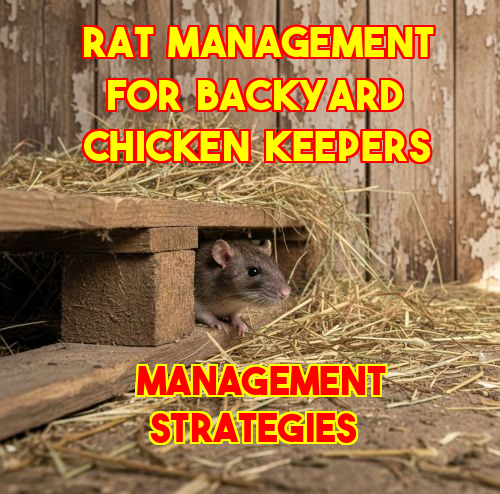
 Where there’s food, there’s going to be a rodent problem, that’s a fact. We already know to store feed in metal cans with secure lids and to close up feeders at night. But even when we do our best, some feed always ends up where rats will undoubtedly find it.
Personally, I’ve tried everything: strong smells, catch-and-release humane traps, cayenne pepper, you name it, I’ve done it. The results have been limited at best. Overall, I would consider those humane efforts a failure. I won’t use rat bait or poison of any kind because I want to protect wildlife, our hens, and companion animals.
Managing a rat problem is about protecting health. Rats can spread disease through their droppings, urine, saliva, and even the fleas they carry. They contaminate feed and water, putting poultry at risk of illness and reducing egg production. They can also transmit diseases to people, especially when dust from droppings becomes airborne. Beyond disease, rats chew constantly. That means damaged structures, compromised insulation, and even electrical wires, which increases fire risk. Left unchecked, a small problem can quickly turn into a serious health and safety issue.
So You’ve Never Seen a Rat Near Your Coop?
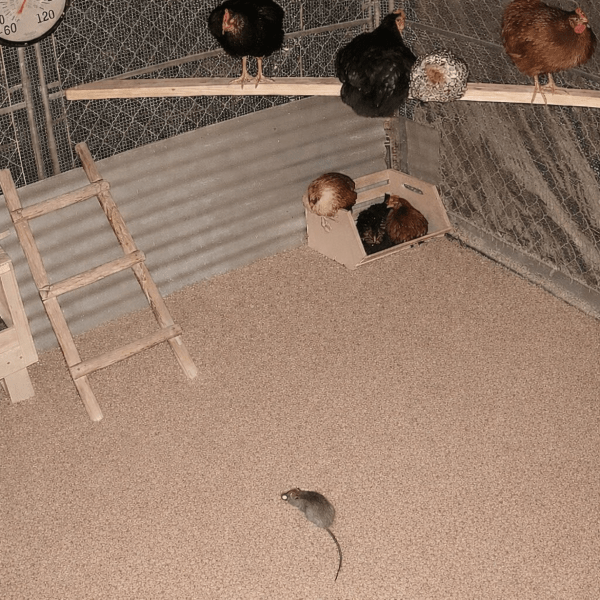
That doesn’t necessarily mean you don’t have them. Rats are primarily nocturnal. While you’re asleep, they’re busy exploring, feeding, and hauling off whatever they can find. During the day, they stay hidden, tucked under structures, inside walls, or deep in burrows where you’d never notice them.
If you really want to know what’s happening around your coop, set up a camera, I think you might be surprised, maybe even shocked.
The footage below was captured at 2 a.m. in my coop. What looks quiet and secure during the day can tell a very different story in the middle of the night.
The Basics of Managing a Rat Problem
Nobody wants to use snap traps, yes, they work for an immediate problem, but I’d rather pass on the knowledge to win the battle long term, the goal isn’t simply killing rats, it’s making your property, uncomfortable, and unrewarding for them. Rats stay where three things exist: food, shelter, and safety. Remove those, and most problems will shrink quickly.
Start by eliminating every food opportunity and be ruthless. Even a tablespoon of spilled feed is enough to reward a rat and keep it coming back. Store feed in metal cans with tight-fitting lids, never plastic, which they can chew through. Remove or close feeders at dusk. Avoid tossing scratch grains on the ground late in the day, collect eggs every day, and secure compost bins and all trash.
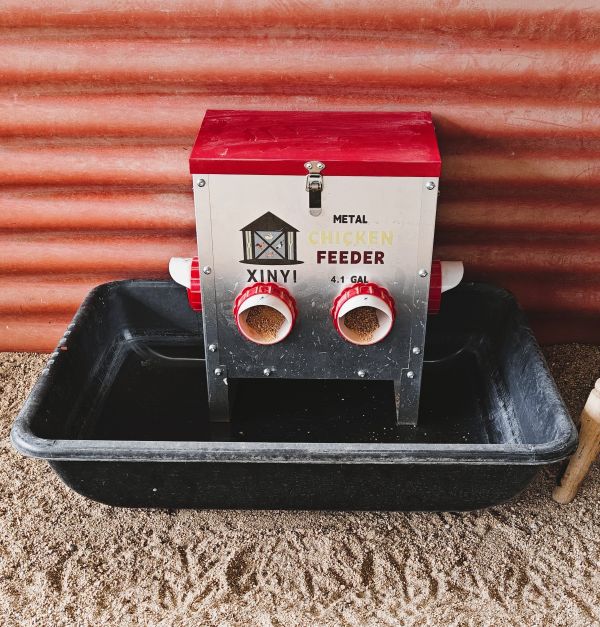
Tip: Put your ground feeders in something that will catch any feed your chickens scratch out onto the ground. Empty it every evening. There’s no point in closing up or removing feeders if there’s a meal for rats scattered everywhere around the feeder. Hang drinkers to the height of your smallest chicken’s back. Ground drinkers provide easy access to water for rats.
If rats don’t get reliable calories, they move on. Keep grass and weeds trimmed short around the coop, and clear away woodpiles, junk piles, stacked lumber, and pallets. Elevate anything stored outdoors at least 12 inches off the ground. Seal gaps larger than half an inch with hardware cloth, not chicken wire, and block openings under sheds, decks, and the coop base. The goal is open, exposed space. Rats avoid areas where they feel visible and vulnerable.
It’s also important to make burrowing difficult. Collapse and flood burrows as soon as you find them, and keep the ground disturbed, since rats prefer stable, predictable soil. Disrupting their environment makes it far less appealing to settle in. At the same time, reduce access to water, which keeps them anchored. Fix leaking hoses or waterers, avoid standing water, and eliminate areas where puddles tend to form.
Above all, be consistent. Management is ongoing, not for just a week or two. Rats reproduce quickly, a single female can produce dozens in a year. When the environment remains hostile and unrewarding populations decline.
At the End of the Day, Remember This…
Keeping chickens means accepting responsibility for the entire environment you create. Rats are opportunists, they go where conditions allow them to thrive. You may never reach absolute zero when it comes to rats. But you can control the population so sightings are rare and damage stays minimal.



 TBN Ranch Chicken Keeping Resources