No poultry or rodents shall be kept in an enclosure within eighty feet of any residence within the City. Poultry may be kept within eighty feet of a residence if written permission consenting to the keeping of poultry less than eighty feet from a residence is first obtained from each lawful occupant and each lawful owner of such residence. Poultry shall not be kept in the front yard area of any lot or parcel within the City. Poultry and rodents shall be kept in an enclosure so constructed as to prevent such poultry and rodents from wandering upon property belonging to others. No more than twenty head of poultry nor more than twenty-five head of rodents nor more than twenty-five head comprising a combination of rodents and poultry shall be kept upon the first one-half acre or less. An additional one-half acre shall be required for each additional twenty head of poultry or for each additional twenty-five head of rodents or for each additional twenty-five head comprising a combination of poultry and rodents. For areas larger than two and one-half acres the number of poultry or rodents shall not be limited. No male poultry shall be kept within the City limits except such male poultry as are incapable of making vocal noises which disturb the peace, comfort or health of any person residing within the City. All such enclosures shall be kept in such condition that no offensive, disagreeable or noxious smell or odor shall arise therefrom to the injury, annoyance or inconvenience of any inhabitant of the neighborhood thereof.
Section 8-5. Manner of Keeping Generally
It is unlawful for any person to keep or maintain any animal or bird in the City in a manner likely to disturb the peace, comfort, or health of any person residing within the City. A person who violates this section is guilty of a Class 1 misdemeanor, however, the City Prosecutor may authorize the filing of certain cases or classes of cases as civil violations unless the person previously has been found responsible or guilty of violating this section. A person found responsible for a civil violation of this section is subject to a sanction of not less than one hundred fifty dollars and not more than two thousand five hundred dollars. In addition to any other penalty authorized by law, a person found guilty of a criminal violation of this section shall pay a fine of not less than one hundred fifty dollars. Can you Have Chickens Where You Live? Check with your local government or health department websites for information on regulations and restrictions regarding raising chickens in your city. Key words: Poultry & Rodent Ordinance
It’s Much Easier to Keep Baby Chicks Warm Than Trying To Keep Them Cool
Revised 4/9/25
Most parts of the country raise chicks in Springtime when the weather is mild. This gives the birds plenty of time to mature through the summer months and be fully feathered by Fall. Not the case here in Phoenix because extreme temperatures of 100+ can start as early as May and by June, reach 110+. These conditions are not suitable for baby chicks, being this hot in a confined brooder is not only stressful but can be life-threatening. Chicks need to have a heat source, yes, this is true, but also need to be able to get away from it to stay comfortable. Improper brooder temperatures also increase the onset of pasty butt (fecal impaction.) For these reasons, in Phoenix, it’s best to start chicks in February, and by April they are mature enough to slowly acclimate to our rising temperatures. Remember, It’s much easier to keep baby chicks warm than try to keep them cool… which is impossible. Chicks are Best Kept Outdoors Raising chicks outdoors in a shed, barn, or garage is the best place to keep your baby chicks. They will most likely only need a radiant heat source. If the weather turns colder at night, a low-wattage heat lamp may assist in keeping the brooder temperature steady. You can buy low-wattage heat bulbs in the reptile section at your local pet or feed store. I usually use a red 75-watt bulb if the brooder temperature drops below 60 degrees. More on using radiant heat & heat lamps.
What to Do When a Chicken Suffers with Heat Exhaustion
Egg Production
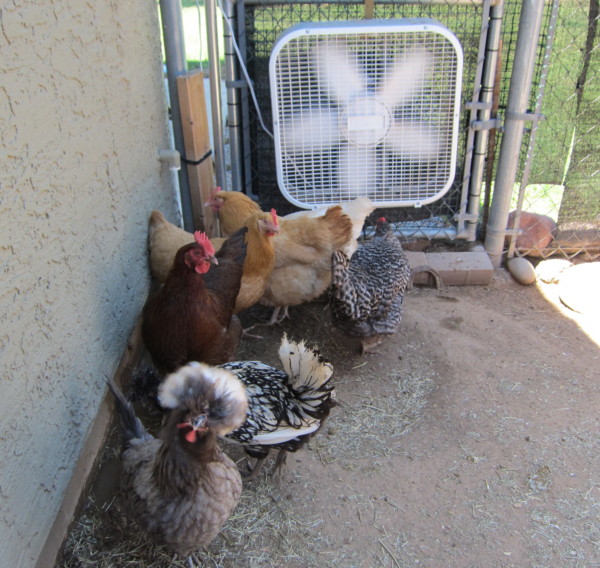
Surviving the Heat in Phoenix, AZ ( Temps can reach 118+) It has been a brutal month for my flock in the scorching heat, Phoenix this summer has well exceeded 110 degrees in the shade, and 115 or higher in the full sun. Over the years I’ve learned to recognize the danger signs of a bird in distress before it’s too late, but learning how to avoid distress in the first place is the real trick. I’d like to share what I’ve found to be the best way. I may not be an expert, but keeping confined chickens in the desert in July with ZERO fatalities makes me dang close! First off, get rid of those standard drinkers, the small plastic ones, and especially the metal ones are unacceptable in extreme temperatures. Buckets of water, dish pans, etc., and notice this recommendation is plural. Watch the sun, place many around the yard where at any given time of the day there is water available in the shade. I like buckets, they are easy to pick up and replace with cold water during the day. You can place a large rock next to the bucket for easier access, but quite honestly if they can’t reach the water without a rock, the water is already too hot and they aren’t drinking it anyway, keeping them full means you’re keeping the water cool. VITAL! I have four buckets in my chicken yard. I hang a box fan on the fence; this without a doubt has made the difference between life and death. Again, I stress the point of buckets of water, because as water evaporates it cools the air, so keep one or more near the fan. Keep the area by the fan shaded, if there isn’t any, make some. Palm fronds, shade cloth, and lattice, all work nicely. Avoid tarps, wood, or anything that will inhibit air movement.
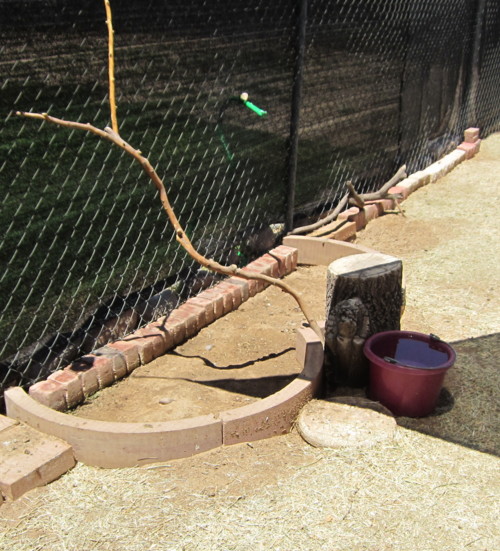
Ground litter including hay and pine shavings hold in the heat, rake everything up, especially chicken droppings which also contributes to an elevated ground temperature. Bare ground is a little extra work for you to keep clean, but a once-over with a rake every day is a small price to pay if it means saving your birds. Don’t discourage hole digging, it’s a perfect place for dumping water buckets during the day, chickens will play in the water and then lay in the mud holes to stay cool. Mist systems are nice, but chickens are not especially fond of them, the air around them however is about 5 to 10 degrees cooler, so you’ll find them congregating near it. The free-standing type run only about $15, I like those best because they aren’t overbearing. Chickens will avoid getting wet if they have a choice; they do however like the ground moisture a mister provides. I keep my mister attached to a hose outside the fence and poke the mister through the fence. Inside the fence line below the mister, I have an area enclosed with a concrete edger [or bricks will do fine] to hold the moisture in. This also provides the ideal conditions for worms – a treat indeed for chickens. Often the birds are too busy looking for worms to notice they are under the mist system.
Fluids are important and water is the best source, but another way to entice them to drink and stay hydrated is watermelon. I cut a seedless watermelon in half and place it in a shallow ground feeder at the hottest time of the day. They will pick it down to the green rind in a matter of 15 minutes. Fresh lettuce and cantaloupe are also beneficial.
Heat Exhaustion, What to Do! A chicken that is suffering heat exhaustion will be lying down, panting, and is lethargic or unable to stand. They lack color and are unresponsive to their surroundings. If you don’t act quickly they will die. Heavy birds such as Orpingtons, Rocks, etc. are the first to show signs of intolerance to extreme heat. Act Fast Again I’ll stress the importance of those buckets of water in the yard, this time find one that is not freshly filled with cold water and place the bird in the bucket of water until it is soaked. Remove the bird from the yard [the others will pick on a distressed bird] and place it under a tree or a shady spot, preferably on grass. If it’s not a breezy day, get a fan on the bird, a low setting is best. Stay with the bird and hold the wings away from the body helping it to cool quicker. I keep a plastic baby pool handy near the chicken yard; after the bird begins to show signs of relief usually about 10 minutes, I place it in the baby pool with about 3 inches of cold water. Within 15 minutes the bird should be standing on its own, and most likely looking for the way out! I then return the bird to the chicken yard, but under observation, until the sun goes down.
Egg Production Egg production has been remarkably good this summer. The only thing I changed this summer was a new nesting structure in the shade. It’s nothing more than four nesting boxes stacked two high on cinder blocks. I never imagined they would use it, I threw a golf ball in one nest box, hoped for the best, and they took the hint right away. It is always good practice to pick eggs as quickly as you can, but it’s even more important to do so when it’s hot, especially if you keep setters. They will sit on those eggs in a billion degrees and literally bake themselves to death in the coop or nest box. I often have to reach under my Orphingtons and take their eggs away, or any other bird’s eggs they claim, then shag them out of the coop. They are not an easy bird to keep in the desert, they are very broody and not at all heat tolerant. I’ve had two this summer that I brought back from near death using the method mentioned above.




 TBN Ranch Chicken Keeping Resources