About the Standard Cochin Chicken

The Gentle Giants

Cochin chickens are known for their soft feathers and fluffy robust appearance. They have a round body, long silky plumage, feathered feet, and a single comb. They lay a fair number of brown or tinted small to medium eggs. You can expect approximately 2 eggs per week.
This breed may not be a prolific layer, but are still quite worthy for their broody tendencies, and their stunning appearance of course! They’re often used to hatch fertile eggs from other birds, however, don’t be in a big hurry, the Cochin is very slow to mature.

If your looking for a docile, peaceful, friendly, and easily-handled breed, this buxom beauty is for you. I find Cochins don’t fancy scratching around in the dirt as much as most other breeds. They are also not a fan of high perches. They prefer free roam but confine quite well.
They’re considered a heavy breed weighing in at about 11 lbs for roosters, and 8 to 8.5 lbs. for hens.
Bantams: A hen will be just under 2 lbs. and the rooster, about 2 lbs.
The Cochin chicken breed arrived on the shores of Britain and America from the port of Shanghai, China in the mid-1800s.  This fancy breed has a wide variety of colorful outfits, in buff, white, black, blue, partridge, and cuckoo.

Back to Chicken Keeping Resources HOME PAGE

The Brahma Chicken

Choosing a Breed for Your Spring Flock? Meet the Brahma!
Cold-Hardy & Heat Tolerant

The Brahma chicken is one of the best choices if you want a feather-footed breed that can handle heat better than most. They are large, calm birds with a calm and gentle nature. While Brahmas were originally developed for cold climates, with good shade, plenty of airflow, Brahmas do quite well in hot climates.
Brahmas are easy to recognize by their big bodies, feathered legs and feet, and broad, sturdy build. Despite their size, they are very calm, friendly, and slow-moving. They are not aggressive and tend to get along well with other birds.

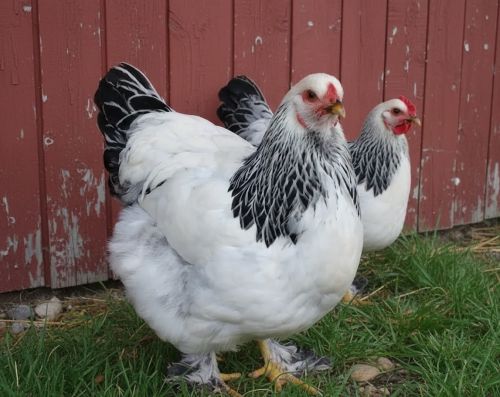
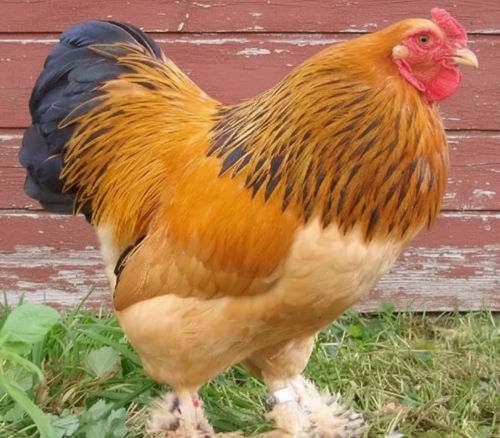
These chickens come in three common colors: Light, Dark, and Buff. Light Brahmas are white with black markings on the neck and tail, Buff Brahmas have warm golden feathers with darker accents, and Dark Brahmas have deeper gray and black coloring. In hot climates, lighter colors such as Light and Buff Brahmas are often a better choice, as they absorb less heat than darker birds.
When it comes to egg laying, Brahma hens are steady and reliable, though not high-production layers. Brahmas do take longer to mature than smaller breeds, usually starting to lay between six and eight months of age, but once they begin, they are consistent.

Back to HOME PAGE

The Dorking

dorking-table-breed

The Dorking is a breed of chicken that is believed to have originated in the Roman era. It is named after the town of Dorking, located in the county of Surrey in England. The breed was first mentioned in literature in the late 16th century and was used primarily for meat and eggs. Dorking chickens are large birds with a single comb and five toes on each foot. They are known for their docile and calm temperament, making them a good choice for backyard chicken keeping. Dorking chickens come in several varieties, including the White Dorking, Red Dorking, and Dark Dorking. They are slow-growing birds and are not as prolific as some other chicken breeds.
Dorking chickens are not known for being particularly good egg layers, and they typically produce fewer eggs than other breeds. On average, a Dorking hen will lay around 80-100 eggs per year. This is lower than many other breeds, which can lay closer to 200 eggs per year. However, the eggs produced by Dorking chickens are larger and may have thicker shells, which can make them more desirable to some people.
Plumage/Colors: Silver grey, Red, White, Dark, Cuckoo
Eyes: Bright red
Comb: Single, large, or Rose
Feet & legs: Featherless, five toes
Cock weight: Large Fowl 10-14lb (4.55-6.35kg)
Bantam: 40-48oz (1130-1360g)
Hen weight: Large Fowl 8-10lb (3.60-4.55kg)
Bantam: 32-40oz (910-1130g)
Egg production – Low to medium
Egg Color – Tinted
Classification – Heavy; Soft Feather

Back to Chicken Keeping Resources HOME PAGE