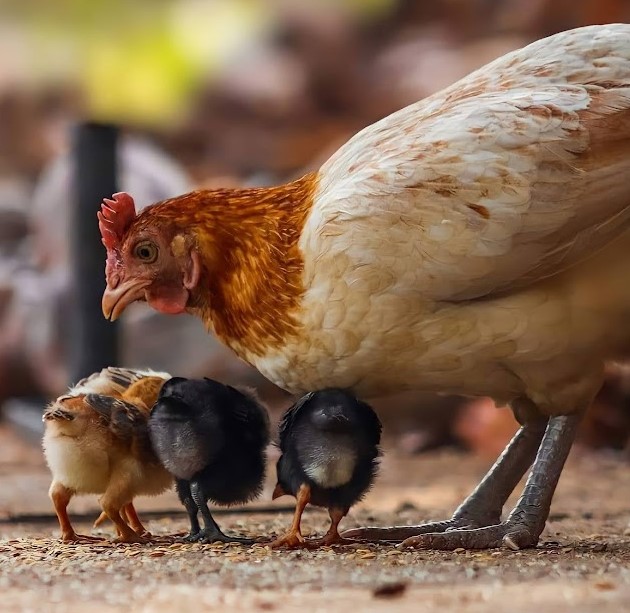
About Grit, your Chicks, and Chickens

Whether or not your flock needs grit is a common question, and the answer can be complicated considering there are different factors to consider. If you’ve already done some research then you know the answer is also a controversial one.  Well, there is an answer, and once you understand what grit is and what it’s for, you can make your own decision on whether or not your flock needs it.
Chickens do not have teeth and grit is used to help digest their food. That’s it, plain and simple! If your birds are in confinement and eat only commercial feed then grit is not necessary. Commercial feeds are formulated to be very easy to digest. But if your chickens are eating other foods that you offer, or are allowed to forage, you may need to provide grit.
What is Grit?
Grit is nothing more than granite, crushed into two different sizes, small for chicks, and larger for chickens.
For Chicks
It’s recommended that baby chicks be provided with grit, then again, chick starter is a commercial feed that is easily digested, so…  grit isn’t exactly vital to their survival either. But, to be safe, yes, I provide grit as a supplement to my chicks in the brooder. You can use grit or clean sand and sprinkle it on the bottom of the brooder, mix it in the feed, or free-feed it. Doesn’t matter, I’ve experimented all three ways and can’t honestly say one is better than the other.
For Chickens
If your chickens are allowed to forage either in a confined area or on acreage there’s only one thing you need to know. What are they foraging on? Is there adequate natural grit underfoot?  If they are confined to a run built off their coop with grass or wood shavings for footing then they need grit, especially if you offer them table scraps.  Here in Phoenix, the ground is granite, so my hens are scratching around on a natural source of grit all day so there’s absolutely no need to feed grit.
Grit is available at your local feed store, it’s cheap and usually sold by the pound. Or, it might be right on your own property, and free!
Just a note…
Chicken grit and oyster shell are not for the same purpose. Grit aids in digestion and oyster shell is used to provide calcium to your laying hens.
Back to HOME PAGE


Keeping Urban Chickens and the Law

Urban chicken keeping is quite popular, your neighbors might even have chickens and you don’t even know it! Chickens are quiet, it’s roosters that are loud and become the neighborhood nuisance. Every city has laws about keeping backyard chickens, but they are seldom if ever enforced unless there’s a complaint. So, no roosters!
There have to be laws and be glad there are, nobody wants to have a neighbor with a gazillion birds stinking up the neighborhood. But I can assure you there aren’t any chicken police knocking on the doors of keepers having a few birds responsibly kept in a clean and secure environment.
Let’s be realistic if you live in a suburban subdivision where the houses are only a few feet apart and you pay an HOA – keeping chickens is a bad choice. Keeping chickens under the radar is also a bad idea, you could have your chickens confiscated by authorities, be fined, or both. However, if keeping chickens is allowed in your city and you have a spacious, private, and fenced backyard, a few hens won’t cause a disturbance. But, there are still rules and unwritten laws to follow.
Your hens should be completely out of sight from all neighbors and the public. That means building a privacy fence or planting bushes that add appeal to your property. It’s never a good idea to draw attention to the fact you are keeping chickens as not everybody will graciously welcome them. Many people believe they harbor disease, smell, attract flies, and rodents, and the list goes on and on. You should have enough space for your hens to be confined in a fenced area attached to a coop or shelter.
My rule of thumb is to keep birds no less than 40 feet from your neighbor’s house, even if the ordinance in your city requires less.  If you can do this, there shouldn’t be a problem with neighbors unless you fail to keep them clean or confined.
Remember, the law may give you the right to keep chickens, but nuisance laws give your neighbors the same right to say you can’t. Be responsible, clean, and maintain your small flock with integrity.

Back to Chicken Keeping Resources HOME PAGE

Chicken Nest Boxes and Bedding

There are many different types of nest box bedding that chicken keepers use. There’s no right or wrong one, you just have to find the one that suits your bird’s needs or preference for the type of nest boxes you have.
Nesting material is important, if your hens scratch around in their nesting box and kick all the bedding out you’re going to have broken eggs.  The kind of nesting boxes you have is also important. If they are semi-enclosed for privacy, such as a wooden box with a hole for entry there is less chance your birds will kick out their nest material. Shredded burlap partially covering the entry hole is also helpful.
Bedding Materials / Pros and Cons
Wood shavings: A great choice if you have a box that will prevent the chickens from kicking it all out of the nest.
Straw: Many people use straw, it’s inexpensive and goes a long way. However, it does get hard and brittle which can cause irritation to the hen’s vent area.  It also tends to mold.
Grass hay: I like it because it’s soft and stays soft for at least a month and my birds don’t kick it out of the nest. But a little spendy.
Sand: Clean, and makes for an easy clean-up using a kitty litter box scoop.
Solutions for Broken Eggs in the Nest Box
Lining the bottom of nest boxes with a cushioning material under the nest bedding can be very helpful if you are finding broken eggs.
Here are a few ideas that are often used as nesting box liners.
Corrugated cardboard
Rubber shelf liner
Carpet, upside down
Artificial turf, upside down
Rubbermaid kitchen sink mats

Back to Chicken Keeping Resources HOME PAGE