Best Time to Buy Baby Chicks in Phoenix is February

It’s Much Easier to Keep Baby Chicks Warm Than Trying To Keep Them Cool

Revised 4/9/25

Most parts of the country raise chicks in Springtime when the weather is mild. This gives the birds plenty of time to mature through the summer months and be fully feathered by Fall. Not the case here in Phoenix because extreme temperatures of 100+ can start as early as May and by June, reach 110+.
These conditions are not suitable for baby chicks, being this hot in a confined brooder is not only stressful but can be life-threatening. Chicks need to have a heat source, yes, this is true, but also need to be able to get away from it to stay comfortable.
Improper brooder temperatures also increase the onset of pasty butt (fecal impaction.) For these reasons, in Phoenix, it’s best to start chicks in February, and by April they are mature enough to slowly acclimate to our rising temperatures.
Remember, It’s much easier to keep baby chicks warm than try to keep them cool… which is impossible.
Chicks are Best Kept Outdoors
Raising chicks outdoors in a shed, barn, or garage is the best place to keep your baby chicks. They will most likely only need a radiant heat source. If the weather turns colder at night, a low-wattage heat lamp may assist in keeping the brooder temperature steady. You can buy low-wattage heat bulbs in the reptile section at your local pet or feed store. I usually use a red 75-watt bulb if the brooder temperature drops below 60 degrees. More on using radiant heat & heat lamps.
Back to HOME PAGE

Winter Chicken Keeping in Phoenix

Preparing the Chicken Coop for the Colder Months Ahead

The winters are rather mild in Phoenix and your birds will be quite comfortable without heat added, as long as they are protected from wind, drafts, and especially rain.
Temperatures rarely drop below freezing in Phoenix, with the usual overnight temperature in the 40s. As long as your birds are kept dry, cool weather is quite welcome, especially after a long summer of brutal heat.
A heavy-weight tarp is a suitable protection from wind, along with ample clean pine shavings (preferred) or straw in the coop and nest boxes. Your birds will huddle together for warmth at night, if you stick your finger deep inside their feathers you’ll see they are toasty warm, even at freezing temps.
Never put a heat lamp in your coop, the risk of fire is far too dangerous. I wouldn’t use a light bulb for heat either. First of all, your birds don’t need it in Phoenix, and second, light is annoying and disruptive to the normalcy of nature.
You will hear other chicken keepers say egg laying is reduced or halted completely in the winter months. That may be so in other parts of the country, but in Phoenix, I never notice much change in frequency. Remember, the key to keeping the egg basket full is defined in two simple words… happy birds.

Back to Chicken Keeping Resources HOME PAGE

Coop or Free Roam?

Every good chicken keeper knows the importance of protecting their birds from predators. Most of us will, or already have lost birds to a coyote, hawk, fox, bobcat, etc. It’s devastating to see the after mass, I know, it’s happened here, I lost seven birds after a coyote attack in 2016. That changed everything I loved most about keeping chickens.
Since the attack, my birds have been completely safe after building them a 10×10 predator-proof enclosure. Unfortunately, that means their happy life of free-roaming our acreage came to a screeching halt. To me, it meant never enjoying my birds out and about, it was now just a chore for their well-being. Chickens live for the opportunity to scratch in the dirt and look for bugs, sunbathe in the morning sun, or find that perfect spot for a dust bath. Since confinement, I’ve noticed the overall health of my flock has not quite been what it was.

The heat plays havoc on confined chickens in the desert southwest, heat stroke is real, and it’s deadly.  Free-roam flocks have a much higher rate of survival and are quite resourceful in finding shade and cooler ground to burrow in.  So this brings me to a dilemma, coop for safety from a predator, or free roam for quality of life and comfort from the extreme heat?
Quality of Life
Today I opened the gate and allowed my flock to live a happy life. After considering the risk, I decided being cooped up in 110+ would have the same outcome as a predator attack… both could mean a death sentence. I will do my part to protect them in every way I can. They will be confined from dusk to late morning, but during the hottest part of the day, they will be free to find comfort.
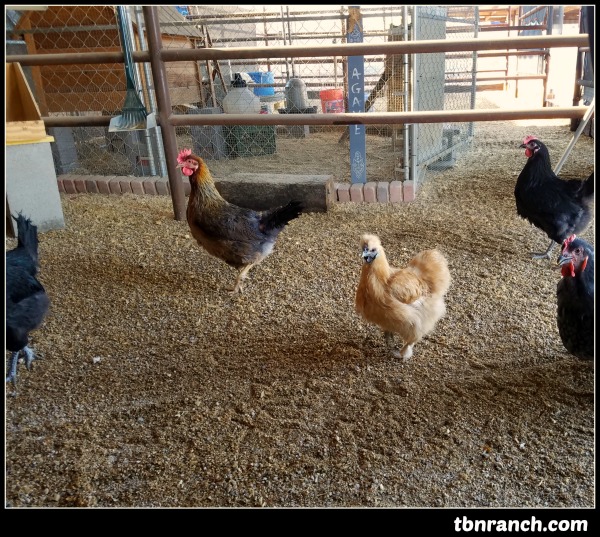
Here are some of the girls who found a comfy place in the feed room… where there’s a giant oscillating fan and mist system. 🙂

Save

Back to Chicken Keeping Resources HOME PAGE

Save

Save

Save

Save

Save

Save