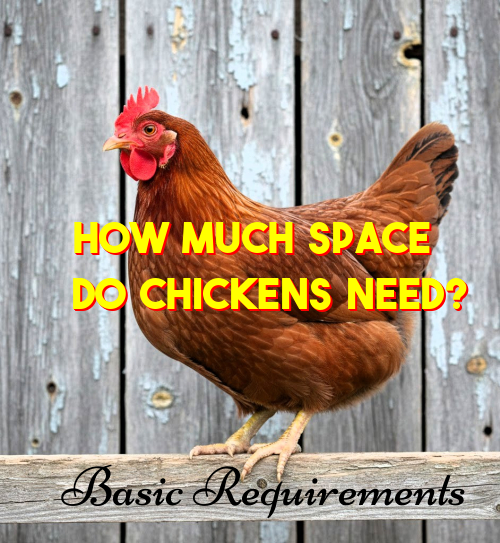
How Much Space Your Chickens will Need

The subject of how much space per bird is often a question of great debate. There are minimum requirement guidelines, but most chicken keepers would agree that 1 foot per chicken is a cramped environment.
If your flock is not allowed to free range during the day and is kept constantly in cramped quarters, you’re going to find yourself scrambling around looking for a way to separate the docile birds from the aggressive ones.  A pecking order is established in all flocks, confined or not. If there isn’t enough room for the weaker birds to escape trouble, you’ll be pretty frazzled by their battles and the sometimes the unfortunate outcome.
You can get away with a small housing space if your chickens will be free-range during the day.  When it’s all said and done, at the end of each day there is usually only one argument… the nests. This problem is usually resolved quickly by the boss hens who choose first, leaving the weaker birds with what’s left.
The best living arrangement for your flock is to offer them space, and the more the better. Happy chickens are those who are free from conflict. Happy chickens are healthy chickens, and that means better egg production.
Recommended Space per Chicken, My Opinion…
At a minimum, 2 square feet of floor space in the coop if your chickens are allowed to free range or have a fenced area attached to the housing area. If your birds are confined all the time, 3-4 square feet of floor space. You won’t gain anything by trying to house too many birds in a small area, the truth is, happy birds fill the egg basket plain and simple.

Need Some Help Choosing A Coop?

Back to HOME PAGE

How Long Does a Chicken Live?

It depends on whether or not they are LUCKY.  Hens on a mass-production egg farm can expect an unpleasant one or two-year lifespan before they are slaughtered.  Not a rosy picture, but wait, it’s even worse if a chicken hatches as a rooster. One may be somewhat luckier than the other… but quite frankly I’m not sure which one.
Backyard chickens can live eight to ten years in an ideal situation. Meaning, quality grub, green fixins, fresh water, shelter, and space to exercise their instinctual behaviors. Of course, there are always chickens with that special gusto for life who continue scratching in the dirt far beyond the norm.
The older a hen gets the fewer eggs she lays. Her production cycle may even cease altogether. But this is just a part of their change of life, the same as ours. Chickens grow old, but let’s not overlook their other valuable ageless contributions. They provide an endless amount of fertilizer for your garden and eat ticks, flies, mosquitoes, and the creepy crawlers that destroy the foliage in your yard. Chickens are hard workin’ bug eating machines that are quite happy to earn their keep…  at every stage of their life.

Back to Chicken Keeping Resources HOME PAGE

About Combs and Wattles, Chicken Anatomy

Both male and female chickens have fleshy appendages at the tops of their heads called combs.  Wattles are two oblong fleshy appendages that hang below their chin.

What Are They For?
They both have a very important function. Scientists suggest that blood is circulated between the comb and wattles to help keep the chicken cool in hot weather. This gives the comb its deep red color and allows the blood to be cooled by the air before traveling through the bird’s body.
In winter, however, the comb is prone to frostbite in some breeds. But, little Vaseline on the comb and wattles will protect them from harm.
Another important function of the comb is to help attract a mate. A large bright comb is a sign of health and vitality. The rooster is at the top of the pecking order and his comb is larger and brighter than a hen’s. But, even among hens, the brightness and size of a comb often decide who is boss.
Chicks will begin to grow a comb within the first few weeks of their life. The comb also indicates maturity in females or pullets. When it reaches a bright red, the pullet is usually at her point of lay.
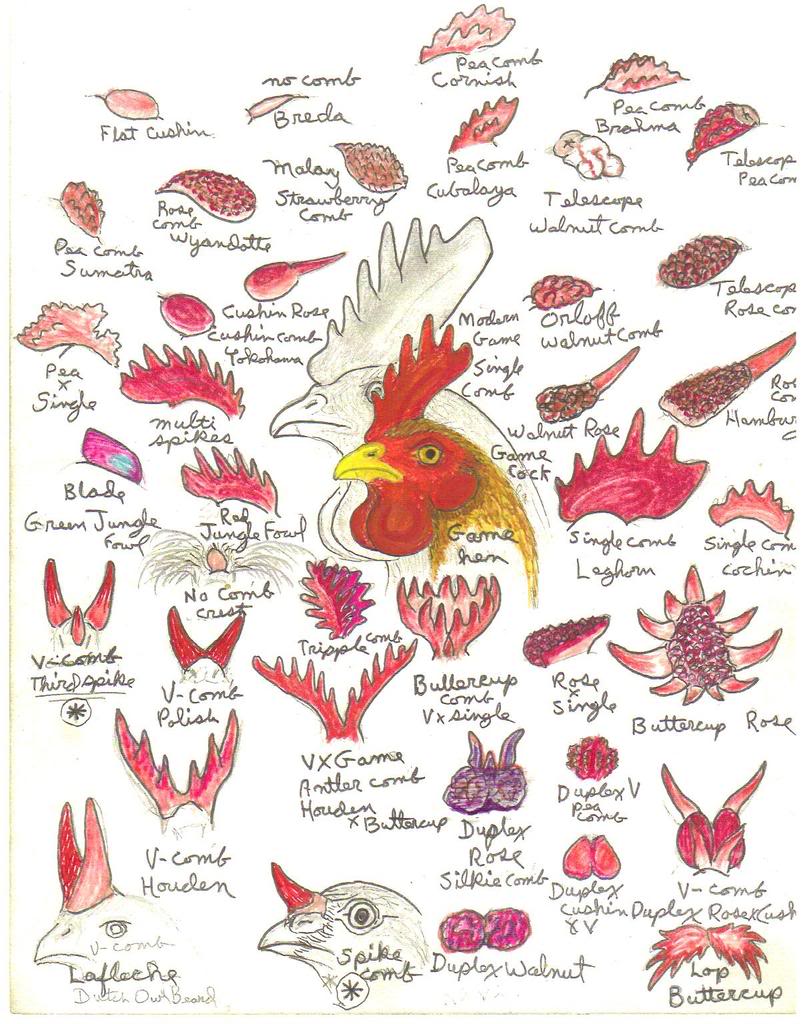
Combs vary in size, shape, and color based on the sex, age, and breed of a chicken.
7 Most Common Combs:
Buttercup
Cushion
Rose
Pea
Strawberry
V-Shaped
Single

Back to HOME PAGE