Fancy Polish Ladies


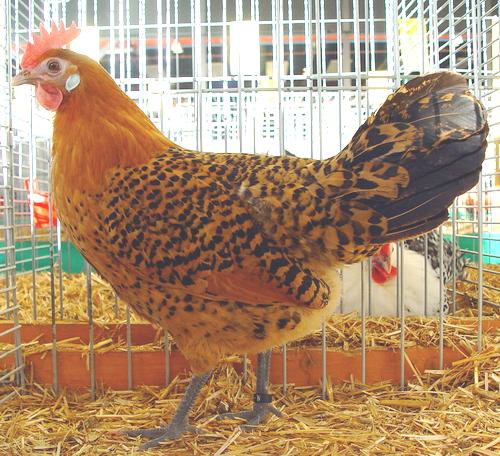
The Campine chicken, pronounced Kam-peen, is a beautiful and rare breed that originated in the Kempen Country near Antwerp, Belgium. They are close relatives of the Belgian Braekel. The Campine chicken comes in two varieties, the Silver and the Golden. Hens and roosters are nearly identical in feather coloration.
In 1893, Campine chickens were first imported into America by Mr. Arthur D. Murphy of Maine and the American Poultry Association recognized the breed in 1914.
Characteristics
Type: Large Fowl
Size: Male: 6lb. / Female 4lb.
Purpose: Egg Laying
Recognized Varieties: Silver & Golden
Crested: No
Feathered Legs: No
Number of Toes: 4
Single comb
Moderately cold tolerant
Not especially docile
Non-setter
Not broody
Tolerates confinement
Alert, intelligent, active
Egg Production
Expect about 3 medium to large white-shelled eggs per week.
Sexing
When Silver Campine females are mated to Golden Campine males the chicks can be sexed at day-old – the female chicks have a reddish blush and the males have gray on the top of their heads.
ALBC Status: Critical
For more information about the Campine visit the ALBC (American Livestock Breeds Conservatory.)

Urban chicken keeping is quite popular, your neighbors might even have chickens and you don’t even know it! Chickens are quiet, it’s roosters that are loud and become the neighborhood nuisance. Every city has laws about keeping backyard chickens, but they are seldom if ever enforced unless there’s a complaint. So, no roosters!
There have to be laws and be glad there are, nobody wants to have a neighbor with a gazillion birds stinking up the neighborhood. But I can assure you there aren’t any chicken police knocking on the doors of keepers having a few birds responsibly kept in a clean and secure environment.
Let’s be realistic if you live in a suburban subdivision where the houses are only a few feet apart and you pay an HOA – keeping chickens is a bad choice. Keeping chickens under the radar is also a bad idea, you could have your chickens confiscated by authorities, be fined, or both. However, if keeping chickens is allowed in your city and you have a spacious, private, and fenced backyard, a few hens won’t cause a disturbance. But, there are still rules and unwritten laws to follow.
Your hens should be completely out of sight from all neighbors and the public. That means building a privacy fence or planting bushes that add appeal to your property. It’s never a good idea to draw attention to the fact you are keeping chickens as not everybody will graciously welcome them. Many people believe they harbor disease, smell, attract flies, and rodents, and the list goes on and on. You should have enough space for your hens to be confined in a fenced area attached to a coop or shelter.
My rule of thumb is to keep birds no less than 40 feet from your neighbor’s house, even if the ordinance in your city requires less. If you can do this, there shouldn’t be a problem with neighbors unless you fail to keep them clean or confined.
Remember, the law may give you the right to keep chickens, but nuisance laws give your neighbors the same right to say you can’t. Be responsible, clean, and maintain your small flock with integrity.
 TBN Ranch Chicken Keeping Resources