Many people believe that a blood spot in a chicken egg means that it is fertile. I’d like to clarify that misconception and explain to you exactly what it is. First of all, these eggs are nutritionally just fine to eat, and there’s no need to be grossed out either. A blood spot in the egg does NOT mean it’s fertile. When you crack open an egg and see that teeny tiny blood spot, be assured it is nothing more than a ruptured blood vessel on the yolk surface that happened during the egg formation process. Or, sometimes in the wall of the oviduct. If the blood spot bothers you that much, it will stick to your finger if you lightly touch it. Out of sight, out of mind!
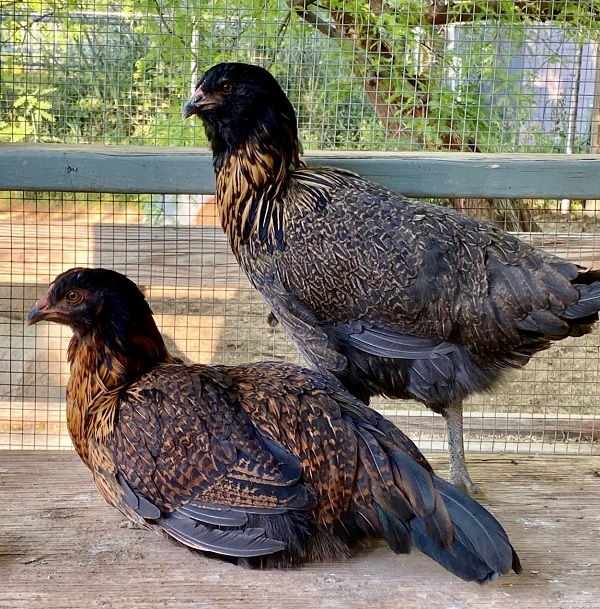
The Dominique, also known as Dominicker, originated in the United States. They are considered America’s oldest breed of chicken, probably descending from chickens brought to New England from southern England during the Colonial Era. However, most modern Dominiques may be traced to stock developed by A. Q. Carter after 1900. By the 19th century, they were widely popular and were raised in many parts of the country. The Dominique is a dual-purpose breed, being valued for meat and brown eggs. They weigh 5 to 7 pounds at maturity, are considered cold-hardy, are good mothers, and adapt well to confinement or free range. They are early to mature, and although sometimes considered flighty, I personally find them extremely calm. The birds’ plumage pattern, also known as “hawk coloring”, offers some protection against some aerial predators.
Egg Production Although categorized as a dual-purpose breed, these birds are first and foremost egg producers with hens averaging 230-275 medium-sized brown eggs. Sexing Dominique Chicks Sexing the Dominique is really pretty simple, with about 95% accuracy. The cockerels have yellow shanks and toes, and the pullets have a grayish-black coloration on the front of their shanks and also on the top of their toes. The color differences become less apparent as the chicks mature. Popularity Concerns Since the 1920′s the Dominique’s popularity was on a steady decline, by 1970 only four known flocks remained. Dedicated breeders participated in a breed rescue and their numbers showed a rise in numbers from 1983 to 2006. By 2007, once again a decline was observed. Presently, the American Livestock Breeds Conservancy (ALBC) has put the Dominique on the ‘Watch’ list. Of all the breeds of chickens I’ve kept here on the farm, the Dominique is by far my favorite. They are very sweet, hardy, and most important in these parts, tolerant to our hot summer temperatures that climb above 110.
When it’s 115 in the shade, it means the thermometer in full sun will register 120 or more. It also means that your chickens are in distress and could face death if you don’t have a plan in place. First of all, if they are caged or in a small coop they will not survive. I know that’s pretty harsh, but it’s true. Find a way to free them where there is some shade, dirt, and water. Shade is a no-brainer, but that’s not enough when the heat is this brutal. They need soft dirt where they can dig a hole to stay cool. Get a shovel and the hose and start prepping an area for them, their instincts to dig will continue from there. Leave the hose on a slow drip in the area where the chickens are, and if possible, securely hang a box fan on the fence any way you can. Put full buckets of cold water somewhat near the fan, this will help cool the immediate area. Make sure you keep their water sources cool, if their water gets too hot they won’t drink it.
Managing the Feed
If you free-feed your backyard flock, don’t. In extreme triple digit temps, it’s better to feed early morning by 6 AM for about two hours, a little mid-day, and again an hour before sundown. Food produces heat causing even more heat stress. It’s also very important to not offer any scratch feeds. However, you can give them beneficial food like lettuce, fruit, and especially watermelon. Cut a watermelon in half and set it in the yard during the hottest part of the day, it’s a great source of fluid and they love it. When is the hottest part of the day? If you’re in the desert southwest, it’s between 3 and 6 pm.